

ESG Information
Social Health and Safety
Promotion of Health Management
Our group believes that each employee’s health is the foundation of our sustainable growth. By fostering a work environment that supports both physical and mental well-being, we promote health management practices that enhance employee vitality and improve organizational productivity.
Acquisition of Silver Certification under the Healthy Company Declaration
As a result of our initiatives based on the Healthy Company Declaration promoted by the Tokyo Pharmaceutical Industry Health Insurance Society and the Tokyo Federation of Health Insurance Societies, we obtained Silver Certification as a Healthy Company (Certification No. Ken-Gin No. 4030) on February 3, 2026.
The Healthy Company Declaration is a certification program under which companies declare their commitment to taking an organized approach to employee health promotion and are evaluated based on initiatives such as health checkup participation, lifestyle improvement, and the development of a healthy workplace environment. This certification was granted in recognition of our having met the required standards for these initiatives.
We will continue to promote the development of a workplace environment in which employees can work in good physical and mental health, and further strengthen our health and productivity management initiatives.
Initiatives for Health Promotion
We regard the maintenance and promotion of employee health as an important management priority and are advancing the following initiatives:
Encouraging employees to undergo health checkups and establishing a follow-up system for re-examinations
Providing information and implementing measures related to lifestyle improvement, including exercise and healthy eating
Enhancing the workplace environment to support employee health promotion
Strengthening support systems with due consideration for mental health
We will continue to enhance health initiatives that employees can proactively access and utilize, and promote sustainable health and productivity management.
Our company is also listed as a certified company on the website of the Tokyo Federation of Health Insurance Societies.
List of Participating Companies
Tokyo Federation of Health Insurance Societies
Foundational Initiatives for Health Management
Health Management Goals
With guidance from occupational physicians, where necessary, we work to maintain and enhance employee health through essential health initiatives. These include preventing lifestyle-related diseases, mental health care, regular and follow-up medical examinations, health guidance, support for balancing medical treatment and work, infection control, and the management of employees engaged in hazardous tasks. After regular health checkups, if follow-ups are required, we issue post-examination action forms and strive to achieve a 100% submission rate of follow-up reports from employees.
Prevention Program
1. Promotion of Regular Health Checkups
We believe it is essential for employees to regularly monitor their health, and we therefore encourage all employees to undergo routine health examinations. We also subsidize comprehensive medical checkups, gynecological examinations, and influenza vaccinations. In addition, we offer access to recreational facilities and contracted sports clubs to help employees refresh themselves both physically and mentally. Through these efforts, we continue to support employees in maintaining good health and performing at their best in the workplace.
We also consider it essential for employees to be aware of their own health conditions and to make efforts to maintain and improve them. Accordingly, we actively promote regular health checkups and aim to achieve 100 percent attendance. Furthermore, we conduct specialized health examinations every six months for employees who regularly engage in work involving organic solvents (Article 29 of the Ordinance on Organic Solvents) and for those who handle, or have previously handled, specified chemical substances (Article 39 of the Ordinance on the Prevention of Hazards Due to Specified Chemical Substances).
2. Specific health checkups and specific healthcare guidance
Disruptive lifestyles lead to future health risks and poor day-to-day performance. We provide with health guidance through specific health checkups and advice to improve their habits to reduce t lifestyle-related diseases such as diabetes and pre-diabetes. Lifestyle-related diseases often progress without subjective symptoms. We provide health guidance so that individual employees can review their lifestyles and change their thinking or habits through health checkups. In particular, we provide specific health guidance to people with high risk of developing lifestyle-related diseases and people for whom lifestyle improvements are expected to be highly effective. We provide a variety of encouragement and advice to help the subjects become aware of their health status and voluntarily improve their lifestyles.
3. Infectious Disease Control Measures
We established internal risk classifications and corresponding measures in response to COVID-19, and these will also be applied to future infectious disease outbreaks. In line with government requests and legal requirements, such as State of Emergency declarations and Priority Measures to Prevent the Spread of Disease, we take appropriate actions based on our internal phase definitions and the evolving situation.
As part of our fundamental infection prevention practices, we promote daily health monitoring, including temperature checks, and instruct employees to refrain from coming to work when feeling unwell. When a confirmed case or close contact is identified, we follow government guidelines to prevent further transmission.
Infectious Disease Control Measures
| Definitions of risk categories and their measures |
Phase 1 (Consideration of infection prevention) Requesting that employees refrain from going out for non-essential purposes |
Phase 2 (Spread of infection) Strongly request that employees refrain from going out |
Phase 3 (Widespread infection) Curfews |
|---|---|---|---|
| Working | Recommending that employees work from home, work from satellite offices, and work staggered working hours | Prohibiting office work (working from home only) | |
| Internal meetings | Recommendation of online meetings | Recommendation of online meetings Prohibiting face-to-face meetings of ten or more people, in principle |
Online meetings only |
| Business travel in Japan | Recommendation of online meetings | Prohibited in principle | Prohibited |
| Overseas business travel | Prohibited in principle | Prohibited in principle | Prohibited |
| External visitors | Permitted only when necessary, with the minimum number of people | Prohibited in principle | Prohibited |
Mental Health Initiatives
Stress checks
We provide employees with an opportunity for stress checks once a year to prevent mental health problems. Employees who are highly stressed in the stress check are encouraged to undergo an interview with an industrial physician. We also conduct group analyses of offices and plants in addition to analysis of individuals and conduct hearings as necessary to improve the workplace environment.
Percent of employees who have undergone a stress check
| FY2022 | FY2023 | FY2024 | |
|---|---|---|---|
| Participation rate (%) | 96.0 | 95.1 | 95.8 |
Counseling Services
In today’s society, where rapid social and environmental changes can make it increasingly challenging to maintain both physical and mental health, we recognize the importance of supporting our employees’ well-being. To help prevent and address stress, serious concerns, and anxiety, we have partnered with a professional mental health counseling service provider. We have established a system that allows employees and their family members to access counseling services at any time. Our counseling services also include support programs to assist employees returning to work after a leave of absence.
Work–Life Balance Support
We have introduced a range of programs to help employees, each with its own unique values, continue working and performing at their best throughout various stages of life.
These initiatives are based on the United Nations Global Compact principles of Human Rights (Principles 1–2) and Labor Standards (Principles 3–6). They are designed to foster a fair and flexible workplace that respects the dignity and diversity of every employee.
Prohibition of Long Working Hours
Recognizing that excessive working hours can negatively impact employees’ health, we manage attendance to ensure that monthly overtime does not exceed 45 hours.
We also take steps to prevent workload from being concentrated on specific employees, review work management practices, and continually improve the work environment to make it more comfortable and sustainable.
In addition, we encourage participation in seminars on labor standards hosted by industry associations and promote responsible departments that further collect and share relevant external information.
| Average overtime hours (hours/month) | 14.5 (FY2024) |
|---|
Encouraging employees to take annual paid leave
We have introduced annual paid leave in half-day increments to enable employees to realize work-life balance. We pay attention to employees’ lifestyles and accommodate diverse work styles.
| FY2022 | FY2023 | FY2024 | |
|---|---|---|---|
| Annual paid leave acquisition rate (%) | 74.7 | 71.4 | 73.3 |
Flextime
This system allows employees to flexibly decide when to start and finish work within a specific time frame. With the significant revision of Employment Regulations in October 2017, this system became widely available, enabling employees to work more flexibly and efficiently.
Leave programs for employees
We offer leave programs, including leave to use during employees’ life events (such as marriage, job transfer, transfer without family, maternity, childcare, nursing care, and care for sick family members), disaster leave, inter-work adjustment leave (interval of 11 hours), leave for women in an impaired physical condition and extended service leave. We provide an environment that enables employees to take leave without hesitation to promote their physical and mental health. Thus, we support them to maximize their performance.
Teleworking system
We have established a teleworking system and rules and encourage employees to use this to achieve the optimal work styles for each job. This new system helps employees work flexibly and appropriately, making balancing work and their private lives easier.
Childcare Support System (support for balancing work and family life)
We provide childcare support services for employees’ children to further support the realization of flexible working styles in each employee’s life stage.
Support for expatriates living overseas
We support making expatriate life comfortable, including language training, various leave programs, health checkups, vaccination assistance, maternity expenses, supplies, and subsidies for children’s education.
Other Support Programs
We provide various forms of support tailored to employees’ different life stages.
Basic Approach to Occupational Health and Safety
At Nihon Parkerizing, we proactively establish a comfortable work environment, believing that improving the workplace environment is essential for employees to perform their duties comfortably. In addition, all employees and related parties, including subcontractors, engage in safety activities together to achieve zero accidents.
Health and Safety Policy
- The Nihon Parkerizing Group will place the highest priority on the safety and health of all of its employees. It will be committed to providing a safe and secure work environment and promoting mental and physical health.
- The Nihon Parkerizing Group will take appropriate preventive measures for health and safety and strive for continuous improvement.
- The Nihon Parkerizing Group will comply with all laws and regulations regarding health and safety.
Health and Safety Management
At Nihon Parkerizing, we have incorporated safety and health management into the environmental management system (ISO14001: 2015) and operate it as an integrated Safety, Health, and Environmental Management System. We have also incorporated a risk assessment mechanism into the management system to achieve sustainable growth. We identify risks and take countermeasures against them to prevent occupational accidents.
The Central Safety, Health, and Environment Committee meets twice yearly to review management under the ISO 14001 standard. Management, labor union executives, and others attend the meetings and discuss various issues.
* We have yet to obtain OHSAS 18001 (now known as ISO 45001) certification.
Safety promotion initiatives
In our group, the Parker Group Health and Safety Environmental Council meets twice a year to establish safe, healthy work environments. The Council shares information on occupational accidents, prevention measures against recurrence, responses to law revisions, and safety patrol results, among others, to reinforce our group-wide safety measures.
As a new initiative, we formulated Parker’s Four Safety Pledges in FY2024. We encourage the establishment of our safety culture by showing these pledges on signs and chanting them.
Parker’s Four Safety Pledges
- We prioritize safety above all else.
- We will always comply with rules and procedures.
- We absolutely will not conduct or allow dangerous actions or work.
- We always assess risks before taking any action.;
- Initiatives implemented by the Workplace Safety, Health, and Environment Committees
Under the provisions of the Industrial Safety and Health Act, Nihon Parkerizing has established Workplace Safety, Health, and Environment Committees at all of its business sites, and each committee carries out activities every month. Targeting all employees of each business site, the committees study and deliberate measures to prevent occupational accidents and health hazards and matters related to health risks and promote specific measures.
- Risk Management and On-Site Improvement
Each workplace continuously reviews work standards and implements safety measures for equipment to reduce employee workload and minimize accident risks. Through Kiken-Yochi (KY, hazard prediction) activities and the collection and analysis of Hiyari-Hatto (near-miss) incidents, we foster an employee-led safety culture. We also promote continuous improvement activities from an on-site perspective, working to maintain and enhance our company-wide level of safety management. Items and procedures necessary for risk management are clearly defined in the Safety, Health, and Environment (SHE) Manual. We identify high-risk operations, assess their risk levels, and implement cross-functional measures commensurate with the risk to prevent serious accidents. In the event of an occupational accident, the Environmental Safety Department promptly collaborates with each business division to share incident information. Details of the accident, its causes, and preventive measures are disseminated to all business sites and group companies to prevent similar incidents.
Furthermore, because our group uses many chemical substances in its business activities, each site conducts Chemical Substance Risk Assessments to ensure that employees can handle these substances safely and appropriately. Through these assessments, we identify the hazards specific to each chemical substance and potential accident risks in factory operations, ensuring thorough and proper management.
- Examples of risk assessments
- Health and safety risk assessment
Based on the Health, Safety, and Environment Manual, we identify risks such as hazardous work to prevent serious accidents. We assess each risk (assessment criteria: seriousness of the outcome, frequency of unsafe behavior, and safety measures against unsafe behaviors), and take cross-sectional steps internally according to the risk level. We check the status of the implementation of risk assessments through internal audit. - Implementation of KYT (hazard prediction training)
In order to improve the ability to predict hazards, we conduct workplace discussions using illustrations and hands-on training. - Work hazard assessment and risk assessment
Beginning with office safety inspections, we investigate actual work hazards and implement risk reduction by suspending work, automating, etc. - Chemical substance risk assessment
We have introduced a system that allows us to assess the risk of hazardous chemical substances and take measures to reduce the risk. We share the results of this risk assessment throughout the company.
- Health and safety risk assessment
Sharing and Using Information about Occupational Accidents
When an occupational accident occurs, the environment and safety department and business divisions cooperate promptly and share information about the accident. Information on accident details, cause of occurrence, and recurrence prevention measures will be shared with all business sites and group companies to prevent similar accidents. Particularly at plants, accident details and countermeasures are shared, reflected in risk assessments as necessary, and reported at each plant meeting to ensure that all workers are fully informed.
In addition, information on each occupational accident is compiled in a database to help prevent similar accidents.
Safety and Health Education and Awareness Activities
We regard improving safety awareness and implementing safe work practices as fundamental to our operations. We continuously provide occupational safety and health education. Safety and health training is conducted for all employees upon joining the company, when changing job assignments, or when engaging in specific work. In addition, as necessary, we provide specialized training and external programs in accordance with the Industrial Safety and Health Act.
To enhance employees’ hazard prediction skills, we conduct safety education programs tailored to job roles, including workplace discussions with illustrations and hands-on training sessions that help employees acquire the knowledge and skills necessary to ensure safety.
In FY2024, we held the 43rd Company Safety and Health Conference in conjunction with National Safety Week, recognizing employees with continuous zero-accident records and hosting a lecture by the Japan Industrial Safety and Health Association (JISHA) on “Explosion and Fire Risks of Chemical Substances.”
Each employee will continue to strengthen their safety awareness and foster a strong safety culture throughout the company.
| FY2022 | FY2023 | FY2024 | |
|---|---|---|---|
| Number of employees who received health and safety training when they joined the company | 23 | 28 | 27 |
Achievements and key initiatives
Ten occupational accidents occurred in FY2024 (two regular employees, two contract employees, four temporary workers and two outsourced workers). We have stayed free from fatal accidents for more than 20 consecutive years. This is a result of our safety awareness and organizational risk management.
Occupational accident frequency rate and occupational accident intensity rate are indicators used to evaluate the occurrence of occupational accidents. Our occupational accident intensity rate in FY2024 was only 0.078, indicating that our efforts to prevent and control serious accidents have been reasonable. However, the occupational accident frequency rate at Nihon Parkerizing alone was 3.25, which is higher than both the previous year and the Ministry of Health, Labor and Welfare’s average (1.30). Problems with workplace safety risk management have come to light.
Based on these results, we believe that preventing accidents and continuing to enhance on-site workers' safety awareness are urgent issues. We will continue to make improvements by leveraging our safety, health, and environmental management system and implementing a PDCA cycle, aiming for zero accidents.
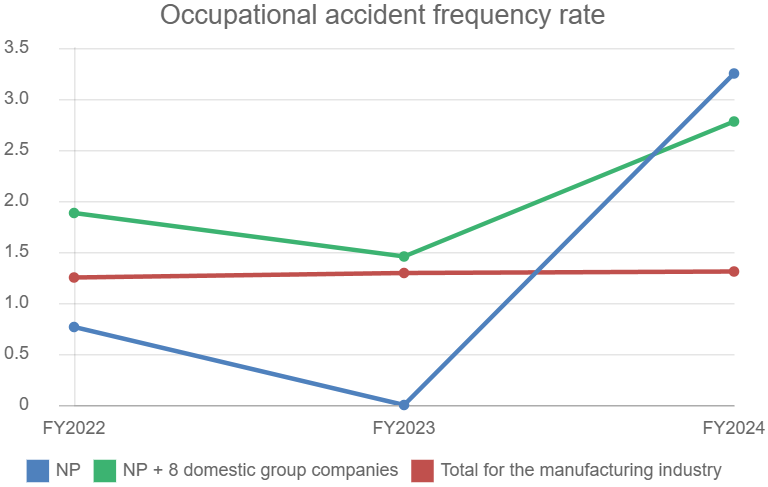
Occupational accident frequency rate =
(Number of casualties / Gross working hours) × 1,000,000
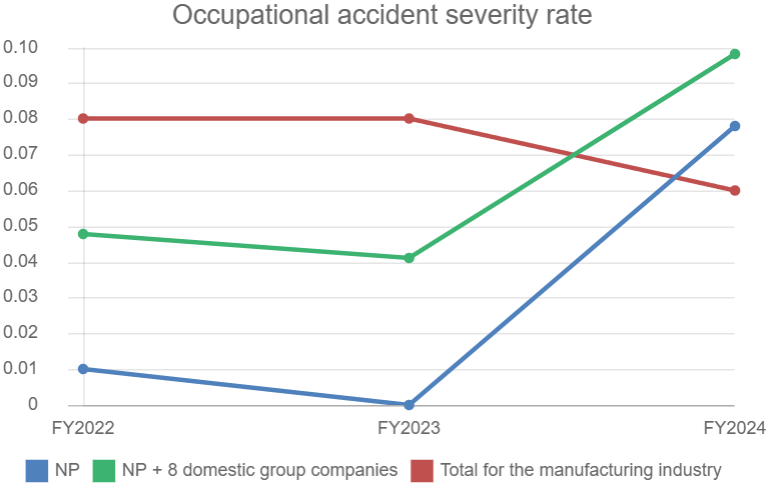
Occupational accident severity rate =
(Number of work days lost/Gross working hours) x 1,000
NP: Nihon Parkerizing
8 domestic group companies: Parker Engineering, Parker Processing, Oita Parkerizing, Komatsu Parkerizing, Japan Kanigen, Hamamatsu Netsushori Kogyo, Million Chemicals, and Kyodoyuso.
Total for the manufacturing industry: Source: Overview of the Ministry of Health, Labor and Welfare’s whitepaper survey on trends of industrial accidents (survey of business establishments (with 100 or more workers each) and survey of the construction work, general including public and private construction work)
| FY2022 | FY2023 | FY2024 | ||
|---|---|---|---|---|
| Number of non-fatal occupational accidents | Full-time employees | 6 | 3 | 2 |
| Dispatched | 1 | 5 | 2 | |
| Contract | 1 | 2 | 4 | |
| Contractor | 1 | 0 | 2 | |
| Total | 9 | 10 | 10 | |
| Number of fatal accidents | Full-time employees | 0 | 0 | 0 |
| Dispatched | 0 | 0 | 0 | |
| Contract | 0 | 0 | 0 | |
| Contractor | 0 | 0 | 0 | |
| Total | 0 | 0 | 0 | |
| TRIR *1 | 0.68 | 0.78 | 0.81 | |
| LTIR *2 | 0.15 | 0.00 | 0.65 | |
| severity rate | 0.01 | 0.00 | 0.78 | |
| frequency rate | 0.76 | 0.00 | 3.25 | |
*1: TRIR (Total Recordable Incident Rate) : Accident frequency rate within statistics per 200,000 total working hours
*2: LTIR (Lost Time Incident Rate) : Lost time accident frequency rate per 200,000 total working hours
Labor-Management Relations and Legal Compliance
Maintaining and Fostering Sound Labor-Management Relations
To develop and maintain peaceful, sound labor-management relations, we have signed a labor agreement with the labor union under the principle of labor-management equality.
The labor agreement stipulates that the company shall grant union members the freedom to engage in union activities unless they violate the provisions of the labor agreement and that the company shall not treat employees unfavorably regarding labor conditions and other matters on the grounds of their union activities.
We hold regular labor-management consultation meetings to discuss labor conditions, the management environment, the company’s management policies and vision, wage increase demands, and other issues. Labor and management share management information and work to enable the reform of union members’ work styles and improve labor conditions and treatment.
We have adopted a union shop system, and all employees permitted to join the labor union are members.
Labor Standards Act Violations
The Nihon Parkerizing Group is committed to strict compliance with relevant laws and regulations, and responds appropriately and in a timely manner to any amendments to such laws and regulations.
In the event of labor violations, we promptly investigate and take appropriate corrective measures. In addition, education and training are conducted to prevent recurrence, and employees are thoroughly informed. In this way, we strive to maintain a healthy work environment.
From FY2022 to FY2024 (April 1, 2022 to March 31, 2025), there were no administrative penalties for violations of laws and regulations.
Employee Welfare
Retirement payments, insurance systems
We have introduced systems including a defined contribution pension plan, an asset-formation savings scheme, an employee stock ownership program, a retirement lump-sum payment system, and a corporate pension fund system. In addition to various social insurance plans, we also provide group insurance, pension for orphans and other bereaved family members, condolence money, and a severe disability allowance to prepare for any eventuality. We are thus proactive in establishing environments where employees can work with peace of mind.